- tips & tricks
- |By Aleksey Haritonenko, Last Updated:
Payhip Pricing 2026: Free vs Plus Breaks Even at $967
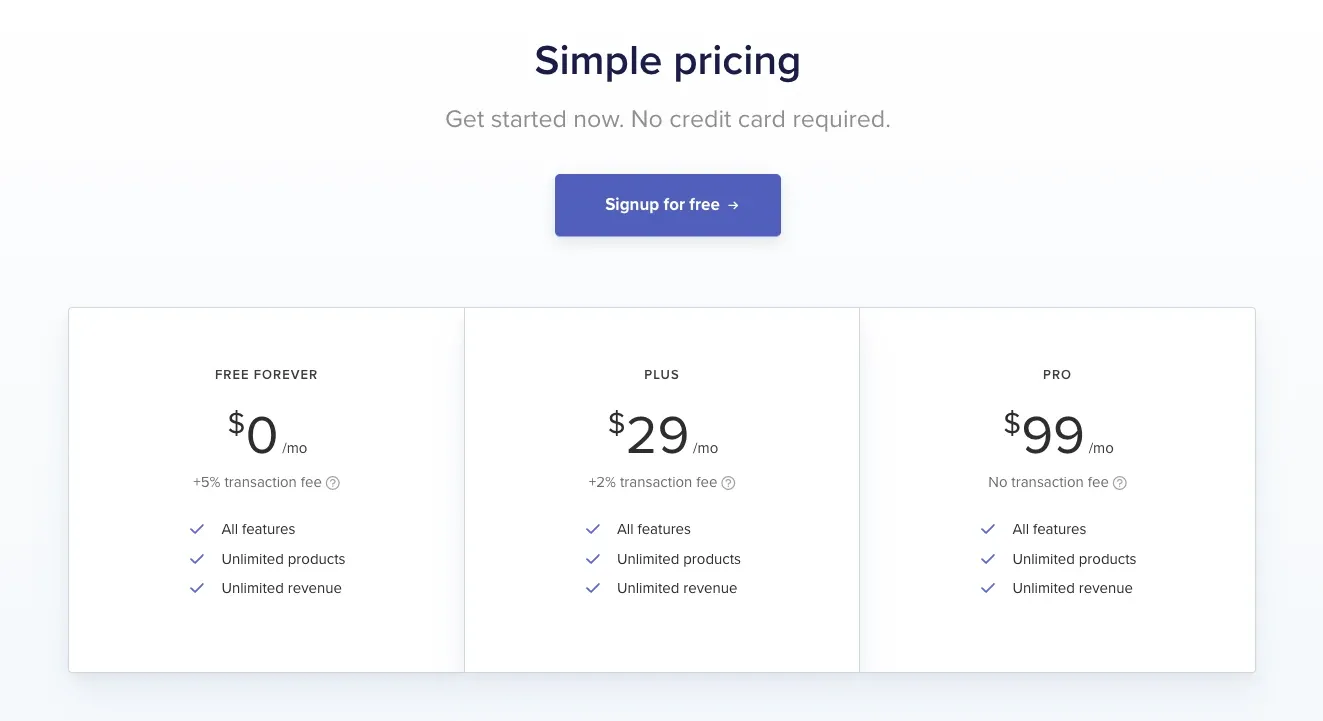
- Payhip runs three plans, all billed monthly: Free Forever ($0/mo, 5% fee), Plus ($29/mo, 2% fee), and Pro ($99/mo, 0% fee) (Payhip pricing).
- Every plan gets an identical feature set (courses, downloads, memberships, physical products, email marketing, affiliate program). Only the fee percentage and the monthly price move between tiers.
- Moving from Free Forever to Plus only pays off once monthly sales cross roughly $967. Below that, the 5% cut costs less than the $29 flat rate.
- Sellfy charges 0% transaction fees on every plan, starting at $22/mo billed annually, with no upgrade needed to get there.
How much does Payhip cost?
Payhip costs $0 to $99 a month across three plans, and the transaction fee drops from 5% to 0% as the price goes up (Payhip pricing).
| Plan | Monthly | Annual | Transaction fee |
| Free Forever | $0 | Not offered | 5% |
| Plus | $29/mo | Not offered | 2% |
| Pro | $99/mo | Not offered | 0% |
None of the three plans has an annual billing option. Payhip's pricing page shows no monthly/annual toggle at all, unlike most competitors in this category, which discount 10 to 20% for a yearly commitment. That makes a full year on Plus $348 (12 × $29), and a full year on Pro $1,188 (12 × $99), with no annual rate to bring either number down.
There's no free trial for Plus or Pro either. The only trial-adjacent language on the pricing page, "Get started now. No credit card required," describes signing up for Free Forever, not a time-limited trial of a paid tier. Testing Payhip before paying means starting on Free Forever and upgrading once the fee math justifies it.
Cancellation is self-serve at any time, per Payhip's pricing FAQ: "you'll be able to cancel your account whenever you'd like if you decide we're not for you".
Sellfy is the store builder behind 75K+ creators. One flat monthly fee, and no commissions on your sales.
Payhip pricing plans: a breakdown
All three plans picked up the same checkout customization tools in a 2026 rollout: banner image, logo, background color, and custom CSS (Payhip: what's new).
Free Forever ($0/mo)
Every Payhip account starts here. It costs nothing and never expires, so the only cost of running it is the 5% cut Payhip takes on each sale.
- $0/mo, no credit card required to sign up
- Unlimited products and unlimited revenue, no cap on either
- 5% Payhip transaction fee on every sale, plus standard payment processing
Because Free Forever never expires, it can double as a live test of the break-even math below. Run real sales through it first, then decide whether Plus or Pro's flat fee actually beats the 5% you're paying today.
Plus ($29/mo)
Plus trades Payhip's percentage for a flat monthly fee. It drops the transaction fee from 5% to 2%, in exchange for a fixed $29/mo cost that doesn't scale with sales.
- $29/mo, billed monthly
- 2% Payhip transaction fee on every sale, down from Free Forever's 5%
The trade pays off once monthly sales cross roughly $967. Below that line, Free Forever's 5% fee costs less than the $29 flat rate; above it, Plus's 2% plus $29 costs less than 5% of the same revenue.
Pro ($99/mo)
Pro removes Payhip's percentage entirely. At a flat $99/mo, the transaction fee drops to 0%, shifting the trade-off from a cut of every sale to a fixed monthly cost regardless of volume.
- $99/mo, billed monthly
- 0% Payhip transaction fee on every sale, the only plan where Payhip takes no cut at all
Payhip hidden costs
Payhip's sticker price isn't the full cost. These items matter before signing up, drawn from Payhip's own pricing page and its recent-changes history. (Payhip pricing)
- Stripe or PayPal processing, on every plan. Payhip's pricing page states that "PayPal and Stripe will still charge at their standard rates once they complete a transaction. This applies for all plans," but it never quotes the processor's actual rate.
- Payhip's own transaction fee, tied to the plan. 5% on Free Forever, 2% on Plus, 0% on Pro. It's the only cost that drops as the monthly price rises, and the one lever separating the three tiers.
- No annual billing option on any plan. Plus and Pro pay the same $29 or $99 every month, indefinitely, with no yearly-commitment discount to work toward.
- No stated payout holding period. This cuts the other way. Payhip's FAQ says sales deposit "immediately after a transaction has been completed," with no threshold or waiting period found on the official site.
- No feature-gating between tiers, for context. Email marketing, the affiliate program, abandoned-cart recovery, and custom domains ship on every plan including the free one. The fee percentage and monthly price are the only things that change.
- Print-on-demand fulfillment isn't confirmed. Payhip's product pages describe physical products and inventory but don't mention POD or dropship fulfillment partners. A creator who needs POD merch has to bring in a separate tool.
- Card requirement on upgrade is unstated. Whether moving from Free Forever to Plus or Pro requires a credit card immediately, and whether billing then auto-recurs, isn't documented on Payhip's pricing page or its FAQ.
Run the math at three revenue points, since the fee that actually scales with sales is the number Payhip's pricing page never totals up. Each row picks whichever Payhip plan comes out cheapest at that revenue level, since none of the three plans are gated by sales volume the way Sellfy's are.
| Annual sales | Payhip (cheapest plan at this revenue) | Sellfy plan · 0% transaction fees |
| $10,000 | Free Forever · 5% fee = $500/yr | Starter · $264/yr |
| $50,000 | Pro · $99/mo flat = $1,188/yr | Business · $708/yr |
| $200,000 | Pro · $99/mo flat = $1,188/yr | Premium · $1,428/yr |
This table isn't a clean sweep for Sellfy. Pro's flat $99/mo has no revenue ceiling, so it holds at $1,188/yr no matter how far sales climb. The real crossover lands earlier than the three rows above suggest: a creator can stay on Business past its $50,000/yr cap and pay a 2% overage instead of upgrading, but that overage passes Pro's flat $1,188/yr at $74,000/yr in sales (Sellfy pricing). Below that point, Sellfy is cheaper; above it, Payhip's uncapped flat fee takes the lead.
Payhip pros & cons
Who is Payhip best for?
Payhip fits three kinds of creators: those just starting out, those with steady sales volume, and higher-volume creators chasing a flat fee.
Creators just starting out. They want to test courses, downloads, memberships, or physical products without a monthly bill, and can absorb a 5% cut while they find out whether anything sells. Free Forever's lack of a revenue cap means they can stay on it for as long as testing takes.
Creators with steady sales volume. Their revenue is consistent enough that a flat monthly fee starts beating a percentage cut, and they'd rather pay $29/mo than watch 5% disappear from every sale. They've moved past validation and are selling on a predictable cadence.
Higher-volume creators. At their revenue level, even Plus's 2% costs more than $99/mo flat, so Pro's 0% fee is the cheaper structure, not just the nicer one. For this group, the monthly price is the only remaining cost to weigh against another platform's own fees.
Payhip customer reviews
Trustpilot's and Capterra's Payhip review pages weren't accessible during research for this article, so both quotes below come from G2, from two distinct reviewers. Treat each as one reviewer's experience, not a wider pattern.
One reviewer praised how approachable the platform is for beginners.
"Payhip is very easy to use and beginner-friendly while still providing the powerful tools that digital creators want in a single platform." Glenn A., Owner (Restaurants) · 5/5 stars · G2 · May 15, 2026
Another reviewer noted the platform doesn't match the customization depth of a dedicated website builder.
"On Payhip, I miss some of the flexibility I'm used to with WordPress, both in terms of visuals and feature customisation." Luis P., Translator · 5/5 stars · G2 · March 16, 2026
The alternative: Sellfy
Payhip's no-feature-gating pricing model is real. Every plan, including the free one, gets the same courses, downloads, memberships, and physical-product tools, and only the transaction fee changes between them.
What the model doesn't include, on any tier, is deep storefront design control or a confirmed print-on-demand catalog.
Sellfy's store editor includes custom domains, custom HTML and CSS injection, and Sellfy branding removed on every plan, including the cheapest one. A creator moving off Payhip for more visual control doesn't need to buy up to a higher tier to get it.
Print-on-demand ships on every Sellfy plan too, with 11 fulfillment centers worldwide and no inventory for the creator to hold or ship. The catalog spans apparel, headwear, bags, and home accessories inside Sellfy's print-on-demand catalog, with a mockup generator to preview a design before it ever prints.
Sellfy has processed $165M+ in creator sales since 2011, across digital products, physical goods, subscriptions, and POD merch sold from the same store.
The comparison isn't one-sided. Payhip includes its affiliate program and abandoned-cart recovery on every plan, including the free one. Sellfy gates its equivalents (cart abandonment, product upselling, and an affiliate program) to the Business and Premium plans, though the 0% transaction fee holds at every tier.
For a full feature-by-feature look at both platforms, see how Sellfy compares to Payhip.
Payhip's only route to 0% transaction fees is Pro, at $99/mo. Sellfy's pricing starts at 0% on the cheapest plan, no upgrade required.
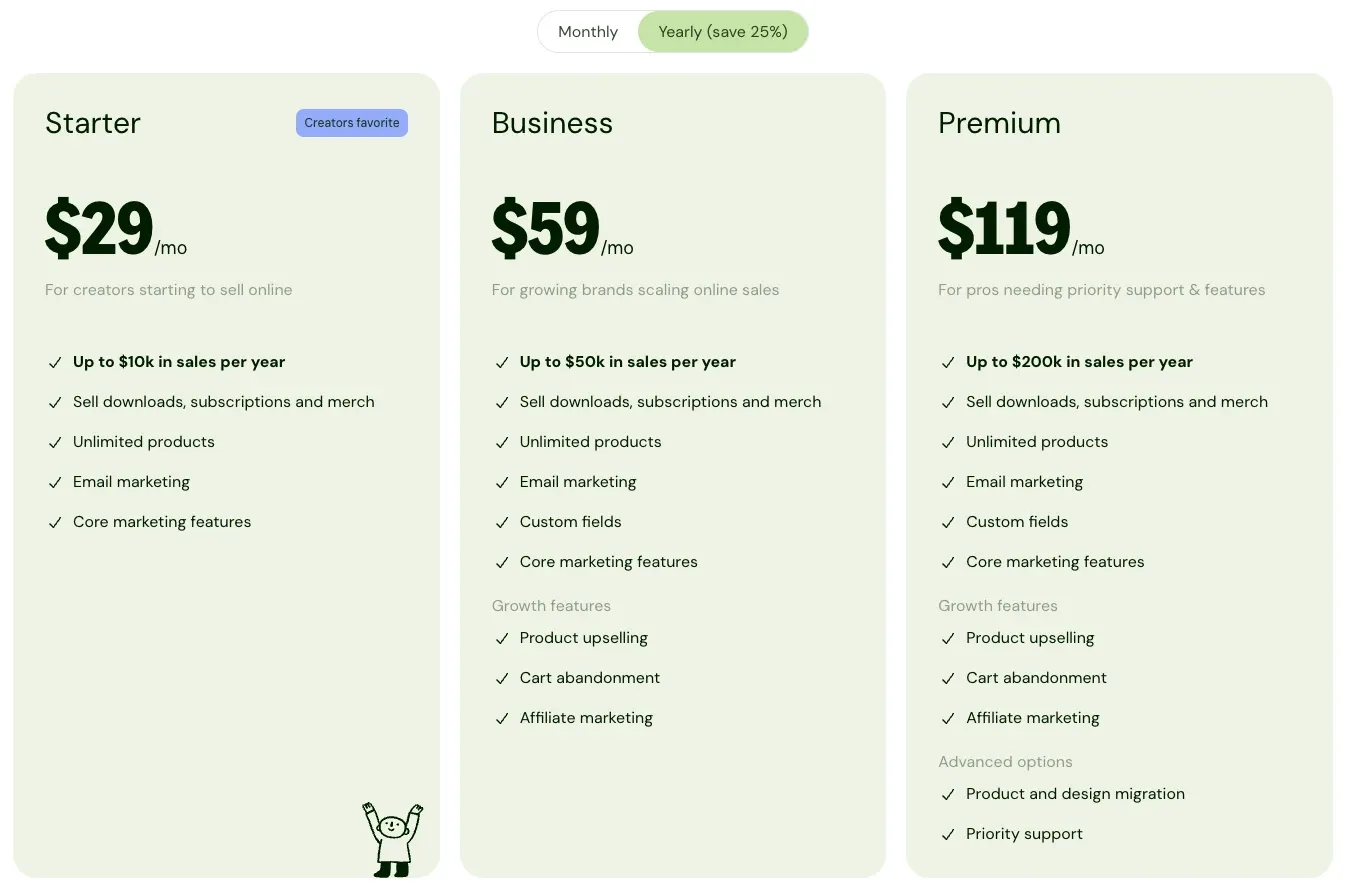
- Zero transaction fees on every Sellfy plan, including the entry tier. Payhip's Free plan still takes 5%, and Plus takes 2%.
- Sellfy Starter costs $22/mo billed annually ($264/yr), less than Payhip's Plus plan ($29/mo, $348/yr) and well under Pro's $99/mo ($1,188/yr), with 0% fees from day one.
- A confirmed print-on-demand catalog on every plan, with 11 fulfillment centers worldwide. Payhip's official site doesn't confirm POD fulfillment at all.
- A no-code store editor with custom domains, custom HTML/CSS, and Sellfy branding removed, on every plan including Starter.
| App | Pricing | Key features |
| Payhip | $0-$99/mo, 5%/2%/0% fee by tier | Digital downloads, online courses, coaching, memberships, physical products, email marketing, affiliate program |
| Sellfy | Starter $22-29/mo, 0% fees on every plan | Digital products, physical products, print-on-demand, subscriptions, video on demand, built-in email marketing |
The verdict on Payhip's pricing
Payhip suits a creator who's fine paying a percentage of every sale at the low end, and comfortable paying more each month as volume grows to bring that percentage to zero. The trade-off is that reaching 0% takes two upgrades instead of one, since Plus still keeps a 2% cut.
Sellfy charges 0% transaction fees on every plan, starting at $22/mo billed annually. See Sellfy's plans and run the math against your own sales.
Sellfy is the store builder behind 75K+ creators. One flat monthly fee, and no commissions on your sales.
14-day free trial · 30-day money-back guarantee · cancel anytime
FAQ: Payhip pricing
How much does Payhip charge?
Payhip charges $0/mo on Free Forever, $29/mo on Plus, or $99/mo on Pro, plus a transaction fee of 5%, 2%, or 0% respectively. Standard Stripe or PayPal processing applies on top of those fees on every plan.
Is selling on Payhip worth it?
Payhip is worth it for creators who want a simple, transparent fee structure and don't mind starting free. The real decision is just which price point's flat fee beats Payhip's percentage cut at your own sales volume.
What are the disadvantages of Payhip?
The main drawbacks: no annual billing option on any plan, an unpublished processor fee rate on top of Payhip's own cut, and unconfirmed print-on-demand support.
Is Payhip cheaper than Shopify?
Payhip's Free plan ($0/mo, 5% fee) costs less upfront than Shopify's cheapest plan, Basic ($39/mo month-to-month or $29/mo billed annually, plus a 2% third-party processing fee, per shopify.com/pricing). At the top end, Payhip Pro ($99/mo, 0% fee) sits between Shopify's Basic and Grow ($105/mo, 1% fee) plans on price.
Does Payhip offer annual billing?
No. None of Payhip's three plans, Free Forever, Plus, or Pro, has an annual billing option or discount. All three are billed monthly only.
Are there Stripe or PayPal fees on top of Payhip's fee?
Yes. Payhip's pricing page states that PayPal and Stripe charge their standard processing rates on every plan, on top of Payhip's transaction fee, though Payhip doesn't publish the exact processor rate itself.

Tips & Tricks

Tips for creators
Join thousands of creators receiving sales tips, marketing resources, and inspiring stories. No spam, pure value.