- success stories
- |By Zane Skuja, Last Updated:
How Jim Pankey Turned Free Banjo Lessons Into a Thriving Online Business
For nearly four decades, Jim Pankey (also known as Wild Jimbo) has been helping aspiring banjo players discover the joy of making music. First through in-person lessons, and for the last 20 years, through his YouTube channel.
Dubbed the “Bob Ross of banjo” by his fans, Jim's friendly, encouraging teaching style has earned him over 150,000 YouTube subscribers and fans across the globe who cross countries and oceans to get to his in-person workshops.
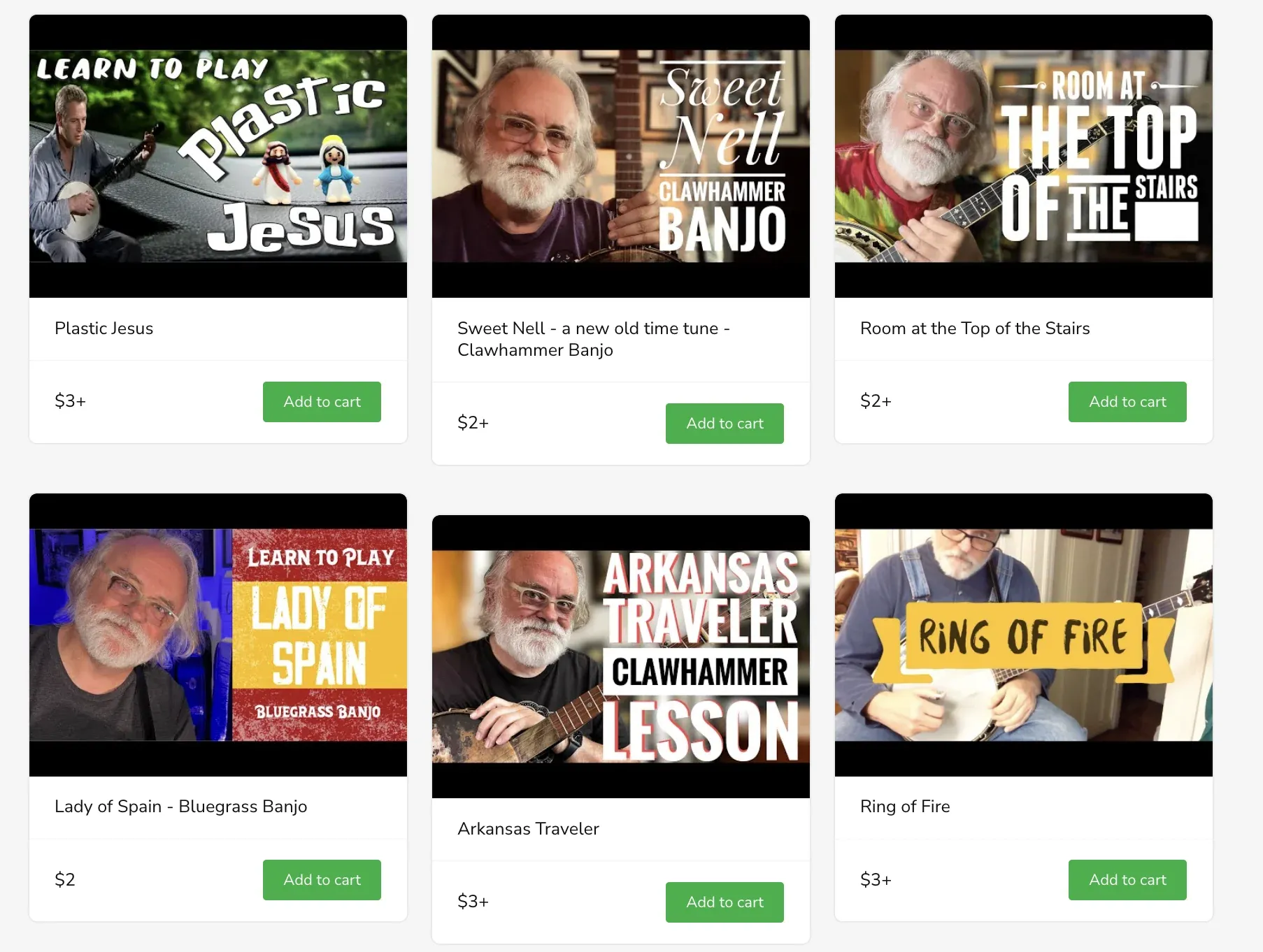
While YouTube monetization has tanked over the years, his Sellfy store has been steadily delivering his digital banjo tabs to learners around the world for almost a decade, most of them priced with Pay What You Want.
In this interview, Jim shares how he turned a lifelong passion for the banjo into a full-time career, how Sellfy helped automate his growing business, and how building genuine relationships, not chasing algorithms, has been the key to his long-term success on YouTube.
What got you started playing and teaching banjo?
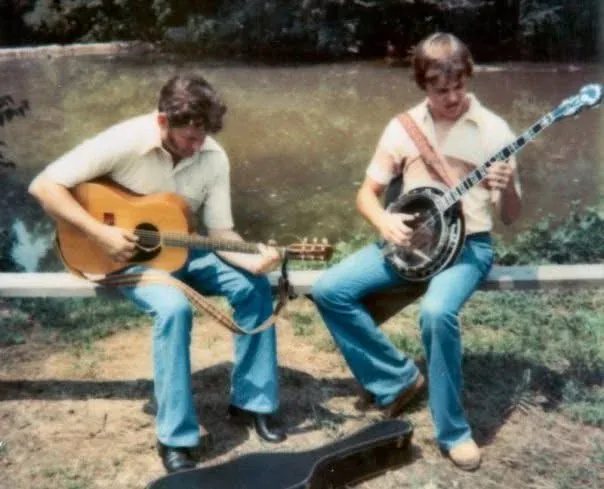
I started playing the banjo in 1977 when I was 13. I was an only child and home alone a lot, and I always liked music. I found my mother's old banjo and a little red book on how to play it, figured out how to tune it, and just started messing with it. Once I started, I didn't stop.
Teaching started pretty soon after. One day I ran into a kid my age, Mark, on the school bus. He played guitar and wanted to learn banjo, so I agreed to teach him. That kick-started my teaching path. I saw it as an easy way to earn some money, so I started getting more students, and I discovered I absolutely love to teach.
What did your career look like before banjo became your full-time focus?
After high school, I didn't pursue music as a profession, but I kept playing, teaching, and performing with local bands. Instead, I got a scholarship and went to college for a degree in agriculture, then started working as a teacher.
Later, I became a human resources manager, where we set up a program for employees to finish their education, and I ended up teaching that class too. Then I moved into banking in operational roles, and it was soon figured out that I could teach there as well, so I ended up delivering corporate training.
It always fell to me to teach, so my YouTube journey was really just a natural continuation of my path as a teacher.
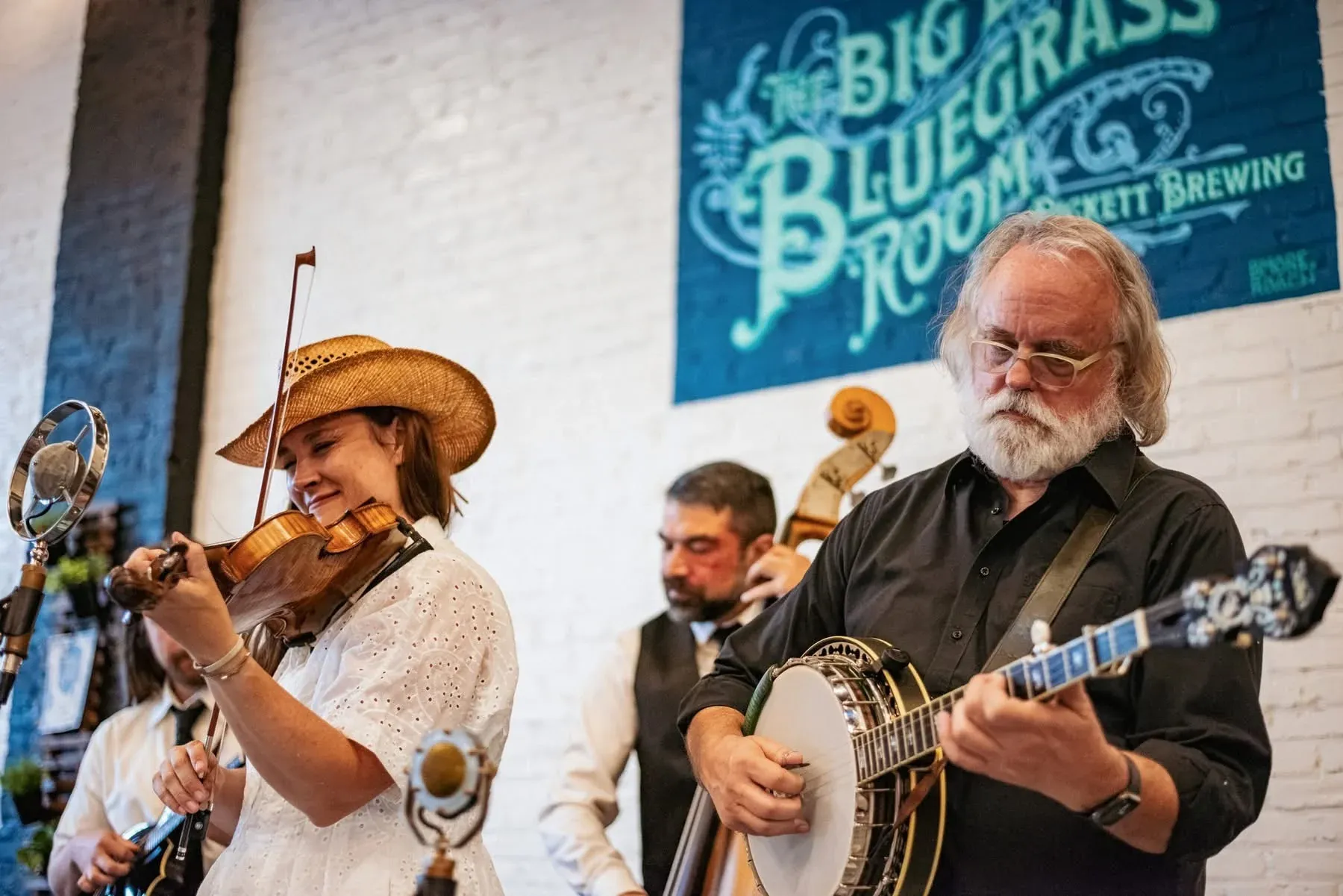
At that time, I was also playing with two different bands, doing 60 to 80 shows a year, more than once a week, and the pay from that covered my bills.
What led you to start posting videos on YouTube?
Around 2006, YouTube happened, and I saw a video of ukulele player Jake Shimabukuro playing “While My Guitar Gently Weeps.” I figured I could do that too, but with a banjo.
I started uploading little performance videos, and they did okay in the online banjo community. Then a local guy asked me to teach him a specific song, but instead of coming to my house, he asked me to make him a video. I did, and he paid me for a full private lesson.
After making a few of these, I realized my instructions were generic enough that anyone could follow them, so I asked that student if I could post the videos publicly. He agreed, and they started to gain traction. Some friends nudged me to start a beginner series. I was reluctant at first, since there were already so many beginner banjo videos out there, but the series took off anyway.
How did you develop your teaching style and personal brand?
I would put a little sticky note with a smiley face next to the camera to remind me that I'm looking at somebody, not just a lens. I teach in a personal way, like I'm the uncle in the kitchen teaching you how to play music, with a positive spin, because so much of the music instruction I saw online at the time felt very sterile and strict.
On my channel, I keep it friendly, laid-back, fun, and very can-do. There are no wrong answers. It doesn't have to be perfect.
“People started calling me the Bob Ross of Banjo because of the positivity and the encouragement I give.”
I also lean into the camera to talk to people from the side, since most of the video is just my hands on the banjo. That became part of my brand too. And I keep production super simple: I shoot everything on my phone and edit with iMovie. I tried nicer cameras and studio lighting once, and my viewers immediately got skeptical, like they didn't trust it. So I went back to basics.
When did you decide to go full-time with banjo?
My switch to full-time banjo teaching happened in 2012. I was an IT officer at a bank, and I'd had enough.
“And then the thought occurred to me: if I work as hard for myself as I worked for the bank, I'll be okay. I knew I would be able to put in the work.”
After I handed in my one-month notice, I slept so well that night. It was a big risk, walking away from the highest-paying job I'd ever had just to play and teach banjo, but I knew people who were doing it successfully, and I believed if they could do it, I could too.
Sellfy is the store builder behind 75K+ creators. One flat monthly fee, and no commissions on your sales.
Soon I realized band gigs are usually weekend work, so through the week I started taking about 20 private lessons. That went okay, until COVID hit and all the in-person lessons and band jobs dried up overnight. Everybody was stuck at home, but luckily for me, demand for my tabs exploded. I'd built a foundation on YouTube since 2006, and that foundation is what let my channel take off during the pandemic.
How does YouTube monetization work for you today?
In the beginning, with fewer subscribers, fewer views, and less watch time, I was making a lot more from YouTube monetization than I am now, probably three times what I make today. My view times and viewer count are about the same, but the money is less, mainly because the platform is a lot bigger and there are far more creators competing for roughly the same number of viewers.
How did you end up using Sellfy?
Over time, demand for banjo tabs emerged from my viewers. I was reluctant at first, since I play by ear and don't write down music, but some tunes were difficult enough that I finally tabbed a few out.
The next challenge was figuring out where to put the files and how to deliver them. I started with a Dropbox account, dropping tabs and selling them for $2 each. That got labor-intensive fast: someone sends $2, I manually send a link. At the height of it, I was doing $500 to $600 a month in tabs, which is a lot of emails. I needed an automated solution, and I found Sellfy through a Google search.
One of my main criteria was that it had to be simple, and everything I read online about Sellfy said it was the simplest e-commerce platform for creators like me. The cost was friendly too.
“Sellfy just works! I rarely have to touch anything. The only time I need to log into Sellfy is if a customer has an issue, or when I'm adding new products or content.”
I've been using Sellfy since 2017, and honestly, I haven't looked at other options since.
What's your approach to creating YouTube content?
I have rules and a schedule to stay on track, and I try to appease the algorithm to a certain degree. I do at least two long-form videos a month, either a teaching video or a collaboration with another teacher or musician, plus YouTube Shorts.
I have a love-hate relationship with Shorts. I made a few lesson series for them, like "bluegrass banjo in a minute," and they got tons of views but had pretty much no impact on monetization.
Coming up with new content is genuinely difficult at this point. I've got 700 videos on my channel, so it's not easy to find the next thing. I sometimes redo old videos, do collaborations, and look through analytics to see what's drawing interest. Lately, that's been more technical content, so that's where I'm leaning.
Sellfy is the store builder behind 75K+ creators. One flat monthly fee, and no commissions on your sales.
Why do you use Pay What You Want pricing for your tabs?
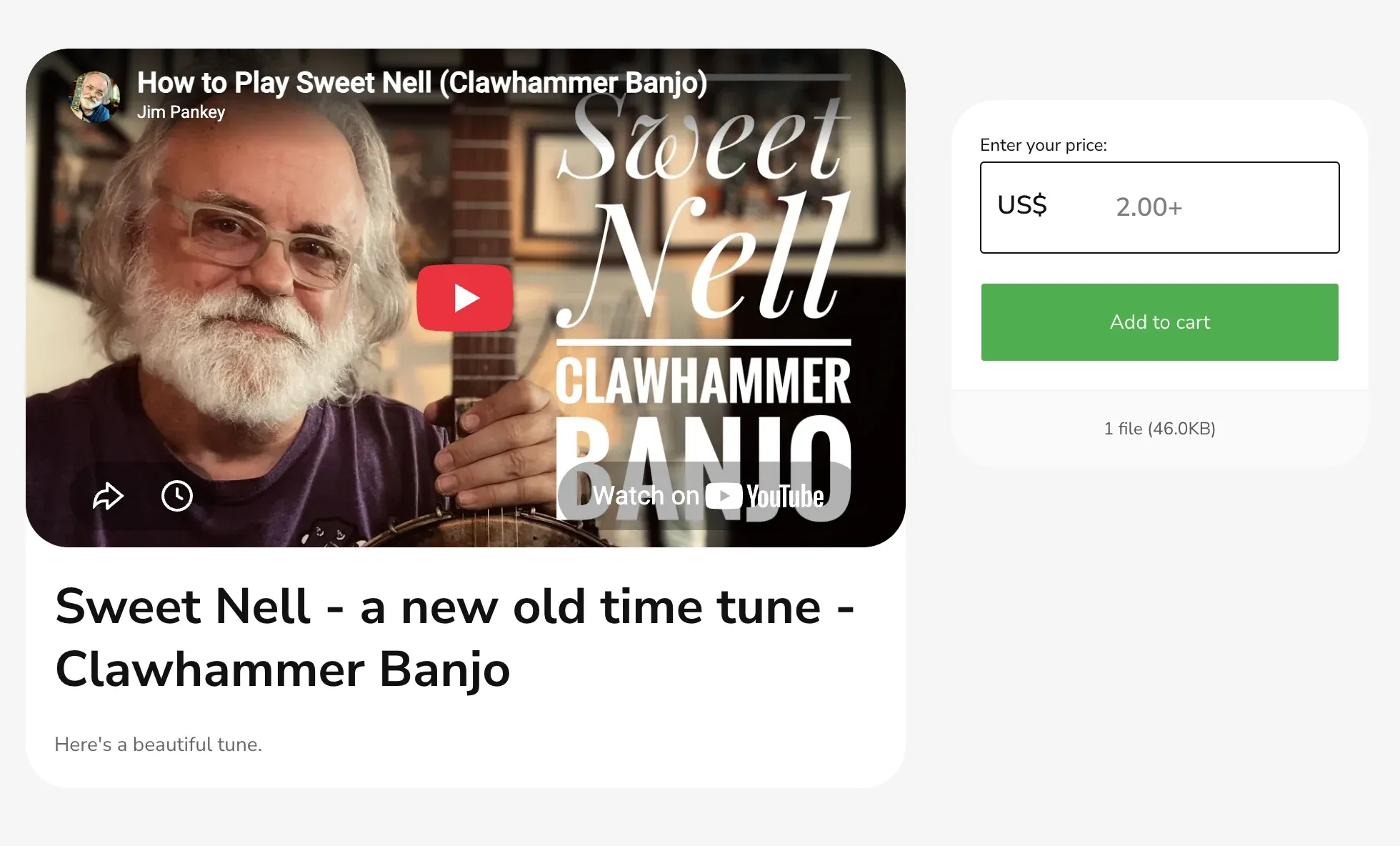
It's about half and half. Half the folks pay the minimum price, and half come in and pay whatever they've decided it's worth.
“I really like Sellfy's Pay What You Want feature, and I appreciate that it's there.”
Some people use it as a way to donate without being part of my Patreon. I've even had people pay $102 for a $2 tab.
Why do you keep your prices so low, even giving away most of your work for free?
To me, music is part of the human experience, and I truly believe that's something we should be giving away. I don't want anybody to not be able to afford it. That's why almost everything I post online is free. The only thing I charge for is my tabs.
I also do in-person workshops that I charge for, but if somebody can't afford the fee, I don't charge them. I want them to learn this stuff.
I have very good friends who create similar content, and most of their work sits behind a paywall. They make anywhere from three to ten times what I make doing this. But my payment is people learning. It's going to a festival and having someone tell me I'm the reason they can play. That means the most to me.
How do you use Patreon?
I have a Patreon, but there's no exclusive content behind a paywall. I'll do a ride-along, take people backstage, show clips of driving to my next workshop, chit-chat about whatever's on my mind, but no lessons.
Patreon is another way for people who've benefited from my free YouTube lessons to support the channel. Membership starts at $2 a month, and I've got about 300 members. I do have a tier with a 30-minute monthly checkup call, basically a video lesson over Google Meet, where they show me what they're working on and I tell them what to fix.
How do you stay connected with 150,000 subscribers?
I do my best to respond to 90% of the comments, even if it's just a thumbs up or a smiley face. I also do live streams, since they're a nice way to interact: people get a chat screen, I can call folks out, and I encourage them to connect with each other.
That's a wonderful thing to see, those folks building friendships in a community that started around me. I know people from my live streams who figured out they live near each other and now get together to play. I have places I can stay across the country now, just because I decided one day to stream a practice session of me sitting and working on a tune.
Responding with a video helps too. It's easier than typing, and especially with music, it's way easier to demo something than to explain it in words.
What role do in-person workshops play now?
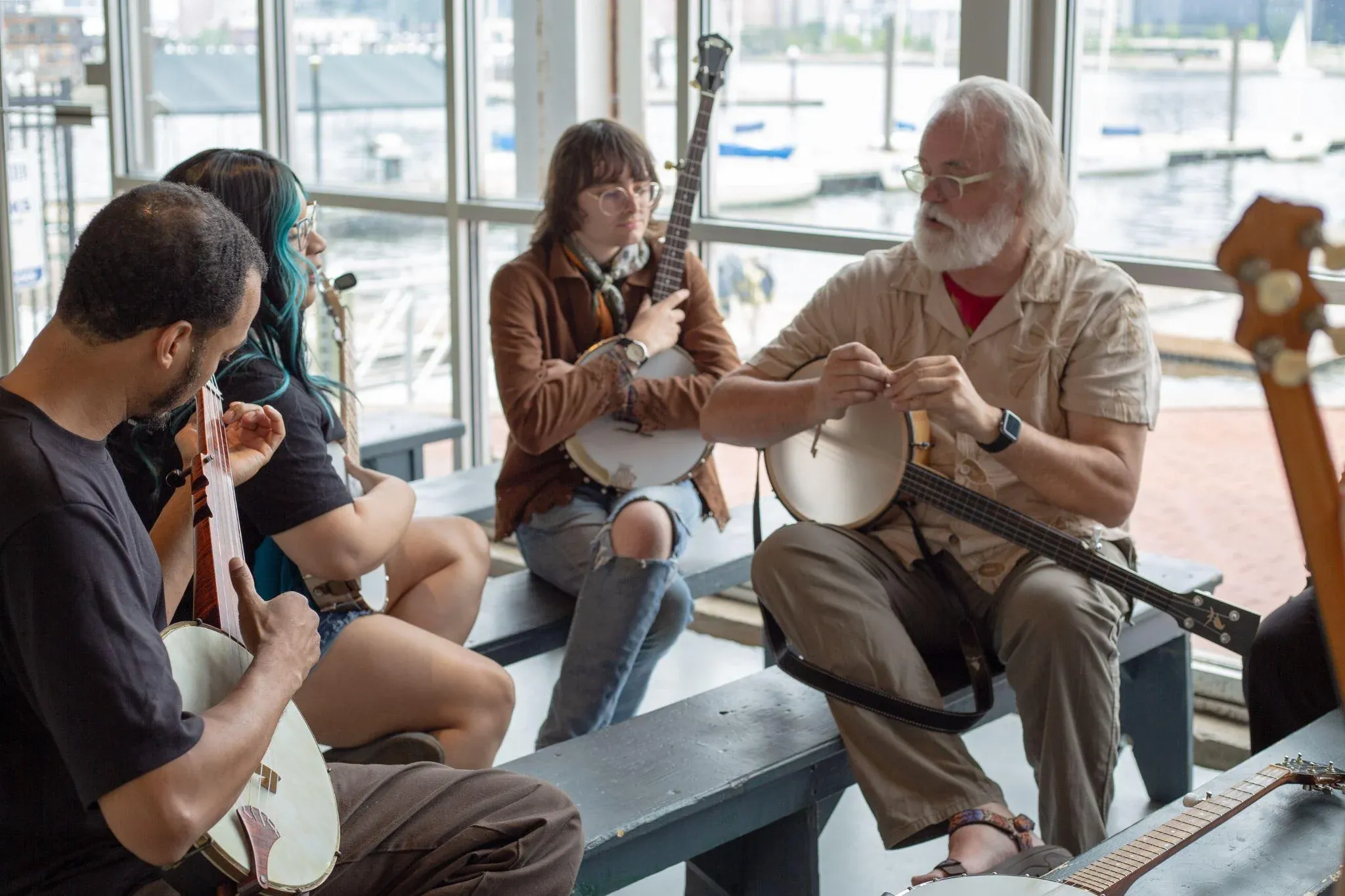
These workshops are another way to stay relevant and show people I'm not just a guy in a box, and I'm pushing hard to do more of them. They're also how I connect with people wherever I go. For example, I'm going to Liverpool, England, next month for a workshop, because three guys from Liverpool came all the way to Chattanooga, Tennessee, for a big bluegrass conference, just because they'd learned to play from my videos.
The best part is that people who come to a workshop get to know each other and keep playing together afterward, building their own local communities. I've seen that happen in a few places where I've taught.
What advice would you give someone building an online business?
First, just be yourself. Don't create a persona or a character. If you're quirky, be quirky. People know if you're fake.
Second, treat every video like you're making it for one person. When I set up my camera with my little smiley face on it, that's who I'm talking to. That's how people watch videos: individually, not as a group.
Third, remember that as content creators, what we ultimately create are relationships, or parasocial ones, and a community around them. Nurturing those connections should be a core part of any online business.

Success Stories
Tips for creators
Join thousands of creators receiving sales tips, marketing resources, and inspiring stories. No spam, pure value.